

How To Set Up A Good Vocal Template In Cubase Artist 10.00
Cubase includes features that allow groove‑based quantization of both MIDI and sound performances, and this month and next I'll look at each of these in plow. To illustrate the process, I'll use a typical example; extracting a groove that I like from a two‑bar drum loop and applying that groove to other cardinal elements of the organization, such as a bass line and rhythm guitar part.
Defining the term 'groove' is non so easy, only most people would hold that a groove (expert or bad!) results from the rhythmic variations a performer introduces into their playing compared to a regular, grid‑based performance of the same notes, and that those rhythmic variations are repeated equally a regular pattern. The sense of 'groove' can be increased when the player as well emphasises (accents) some notes inside the pattern.
In essence, and so, to obtain the 'groove' of a operation nosotros need to extract its regular pattern of both timing (and, in particular, timing that doesn't fit the regular musical grid that might exist set past a metronome) and playing dynamics.
Capture The Feel
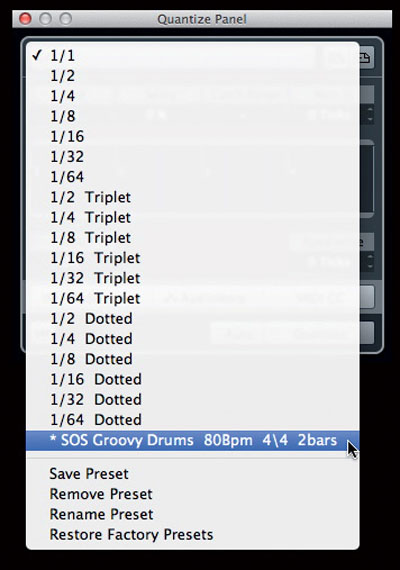
When information technology comes to capturing a groove from a MIDI functioning in Cubase, you really have very trivial command over the procedure: yous just select the MIDI part you want to take the groove from and choose the Edit/Advanced Quantize "Create Groove Quantize" choice. If yous then open the Quantize Panel (Edit/Quantize Panel), you'll see your freshly captured groove in the drop‑down listing of available grooves at the top of the panel.
Note that, by default, this new groove is given a name to match the name of the MIDI part from which it was taken, but you lot can edit this to create a more meaningful label. Also annotation that when y'all first capture a groove, the proper name has an asterisk (*) character beside information technology to remind yous to press the save preset button (located next to the drop‑downward card).
Although you tin can't change the mechanics of the extraction procedure itself, in that location are two significant things you can practise prior to the extraction that influence only how bully your captured groove volition be… First, you need to decide where exactly yous'll excerpt the groove from.
If yous only have a short MIDI operation as your source (two or four bars, for case), the choice is uncomplicated, but if yous have a longer functioning (for example, a complete pulsate functioning generated from an electronic kit), you lot demand to decide whether to use all of it or just a selection. Given that one of the key elements of establishing a groove is its repetition, selecting the 'grooviest' few confined is probably the simplest starting bespeak.
When you extract a groove from a MIDI part, MIDI velocity and note-length information are also extracted, and, as we'll see in a moment, y'all can then choose how much of the MIDI velocity pattern is applied when y'all superimpose the groove onto another MIDI performance. If you call up the original MIDI functioning lacks a little something in terms of book dynamics, then, it's a good idea to go in and tweak the MIDI velocity data a picayune, or utilize the Functions/Velocity options to expand the MIDI velocity range, prior to extracting the groove.
Groove Awarding
Applying a groove preset that you lot've created to other MIDI parts is very simple and — unlike the extraction procedure — you get some user command. If you select the MIDI function to which you wish to apply the groove preset, and and so open the Quantize Panel, you lot can select your new groove preset from the driblet‑downwards list. You tin can and then tweak the various Quantize panel controls to accommodate just how 'hard' you utilize the groove quantize to this MIDI part. These controls are described in the Cubase Operation Transmission, then I won't go into too much detail here, simply the key starting points are Position and Velocity.
A Position setting of zero pct means that the MIDI notes within the office aren't affected by the timing of the notes in the groove preset. By contrast, 100 percent means that notes are moved to match the groove exactly. Conspicuously, you tin can conform this setting to taste, depending on how tightly you want the diverse performances to lock together, and I detect that a value of 70 percent is a skilful starting signal for a tighter feel, without taking away all the natural variation within the original performances.
Velocity is also expressed as a per centum value and behaves in a like style; zero pct ways that the velocities of the groove preset aren't superimposed on the MIDI part, whereas 100 per centum produces a close match in terms of playing dynamics. Once more, adjust to gustation. The Max Motility setting allows you to identify a limit on how far notes tin can exist moved by the quantize process, and the Randomize setting can exist used to add but a bear upon of 'human' variation: both are well worth experimenting with.
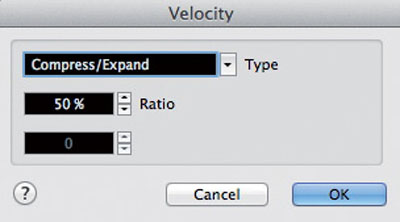
If required, the Functions/Velocity carte du jour choice allows you lot to adjust MIDI velocity dynamics prior to groove capture.
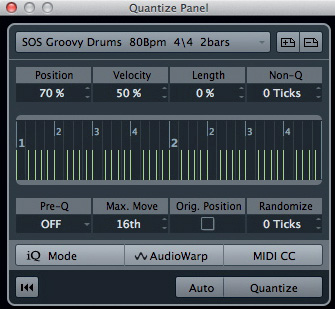
The Quantize Console allows you to control how 'hard' the groove is practical to other parts. All of these controls are also available via the Quantize tab of the MIDI Editor window.
In one case you've adjusted these settings, pressing the Quantize button applies them, only you lot besides have the option of engaging the Auto push button, which means that settings volition be practical automatically every bit y'all brand changes. Both note‑start positions and velocities will be adjusted.
Because the quantize procedure is non‑destructive, yous can brand further changes and repeat this process every bit often equally y'all wish: you tin can disengage all of the effects of the quantization by pressing the Reset button, located at the lesser‑left of the Quantize Panel. If in that location are times when yous desire to commit to the applied quantize, fifty-fifty if but to reduce the likelihood of resetting your perfectly locked groove by accident, Edit/Advanced Quantize/Freeze MIDI Quantize volition do the play a trick on.
These staff of life‑and‑butter groove‑transfer techniques are useful, simply the same tools tin likewise be used for more advanced tasks. For example, it'southward well worth experimenting with applying a short fragment of extracted groove to the remainder of the longer MIDI performance from which it was taken, to see if it helps (by making the groove experience more consistent) or hinders (by killing the natural variation in overall feel created past the musician).
Alternatively, you can choose just to use a short section of the performance for the various instruments (as I've washed in my example), and so loop that section, or to retain the whole performance and apply the groove to all of it. Both can piece of work, the former giving greater potential for an ultra‑tight finish effect, while the latter may produce something with a more natural flow.
Last Thoughts
The example I've used to illustrate the MIDI groove-quantize process is deliberately a simple one: a two‑bar pulsate loop provides the groove that's practical to other two‑bar loops for bass and rhythm guitar parts, both of which are MIDI based. In a total production, though, things will usually exist rather more complex. For instance, even if you lot take the most uncomplicated of verse‑chorus song structures, you might experiment with ane groove applied to all the vocal sections or a split up groove applied to each key song section. This is, of class, a creative decision, simply Cubase has all the tools y'all need to practise the required experimentation hands and rapidly.
Finally, of class, we've been working only with MIDI hither, but most of the states at present work with MIDI and audio aslope each other — then next calendar month nosotros'll await at how y'all can get both of these locked nicely into the aforementioned groove.
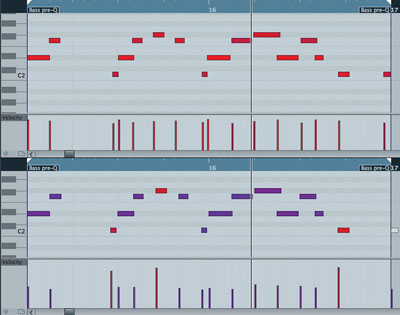
The 2‑bar bass line without (above) and with (below) the groove applied. Annotation the subtle shifts in the starting points of some notes in the lower version and how the Velocity setting has been (deliberately over) used so that three notes are now heavily accented to mirror beats which had emphasis in the pulsate loop that formed the source of the groove
Original post source here

How To Set Up A Good Vocal Template In Cubase Artist 10.00,
Source: https://www.loopmasters.com/articles/2064-Cubase-Groove-Quantize-Part-1-Extract-Groove-From-MIDI
Posted by: andersonliet1959.blogspot.com
0 Response to "How To Set Up A Good Vocal Template In Cubase Artist 10.00"
Post a Comment